
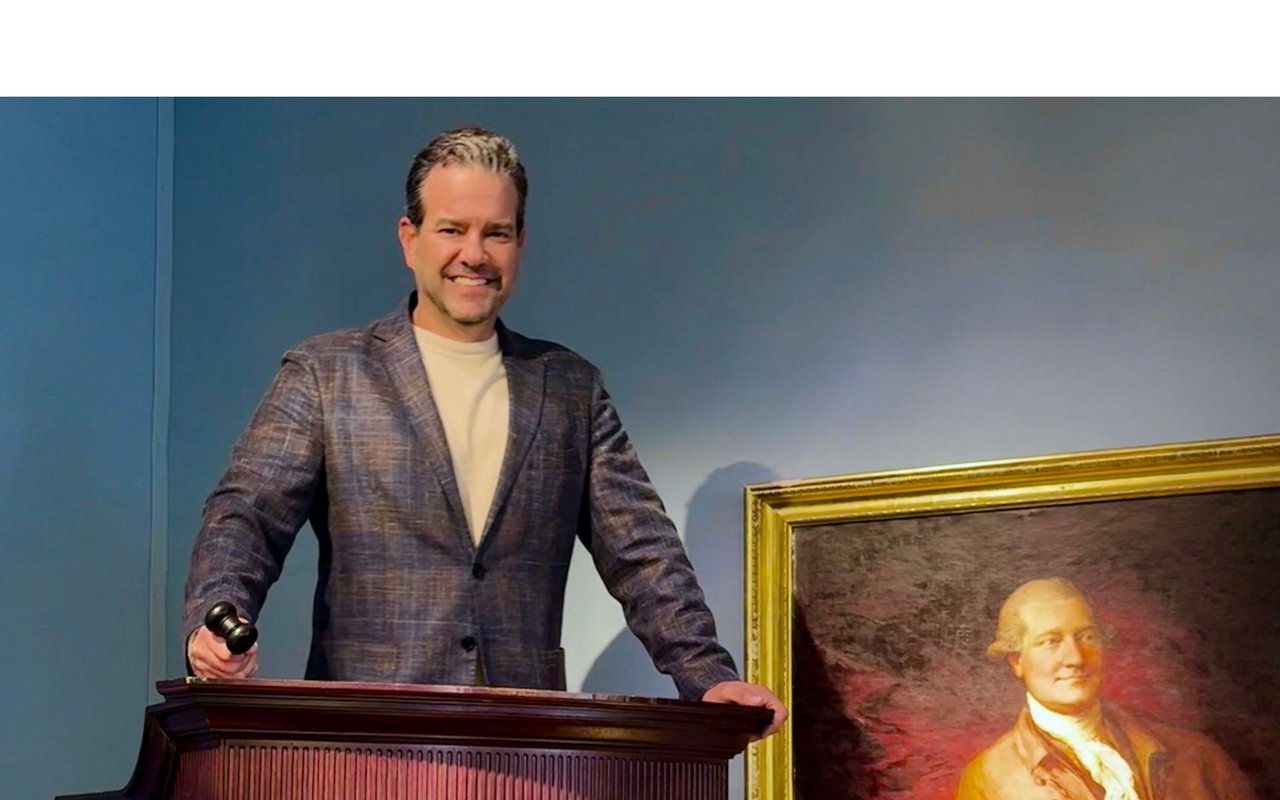
Eight years ago, when I joined Christie’s International Real Estate, I thought I understood what I was getting.
A respected luxury real estate brand. An international network. A connection to one of the best-known auction houses in the world.
All useful things for an Aspen real estate broker.
What I did not expect was that Christie’s might send me back to school.
I got my real estate license in 2006. Since then, I’ve sold Aspen real estate through the boom years, the Great Recession, the extraordinary post-Covid market and just about everything in between. After roughly 20 years and a couple hundred transactions, it would have been pretty easy to simply keep doing more of what I already knew how to do.
Sell houses. Find buyers. Win listings. Negotiate deals. Repeat.
Instead, over the last several years, I’ve found myself becoming a student again.
Art. Auctions. Watches. Collecting. Galleries. Architecture. The art market. International travel. And, maybe most importantly, people whose interests and lives intersect with all of those things.
For my real estate clients, that has translated into a wider network of relationships, specialist introductions, international marketing opportunities and a better understanding of the world many of them inhabit.
But the more interesting part, at least to me, is that I never set out with some grand business plan to make that happen.
I simply got curious.
Becoming a Student Again
I did not come from a serious art background, and I certainly don’t present myself as an art expert.
I’ve always appreciated art. But at some point I decided that if I was going to spend more time around it, I wanted to actually understand what I was looking at.
Through Christie’s Education, I began taking courses online and later studying in person in New York and London. I’ve attended auctions, studied different aspects of the art market and art advisory, met instructors and advisors, and kept learning from some of the people I met along the way.
I joke that one of the things I particularly enjoy is that there isn’t a test at the end.
What there is, however, is no end to the subject.
You start learning about one artist and suddenly you’re learning about the period in which that person lived. That leads to history, politics, economics, religion, war, technology, psychology, beauty, status and all the other things human beings have spent centuries trying to understand.
One artist leads to another. A painting makes you want to see a museum. The museum makes you want to visit a city. Then perhaps a gallery, an auction or another country.
Art becomes a way of studying people and the world they created.
At this stage of my life, I find that endlessly interesting.
The Rolex That Got a Little Out of Hand
Watches are probably the funniest example of how this has unfolded.
When I turned 50, I bought myself one nice Rolex as a milestone birthday present.
That was basically the extent of my watch-collecting career.
Then I took a watch course through Christie’s.
I started learning about movements, design, history, craftsmanship, brands and why collectors care about particular references.
Apparently I was a fairly receptive student.
One Rolex became curiosity.
Curiosity became more watches.
And somewhere along the way I ended up with what could reasonably be called a collection.
Something else happened, too.
Watches became an extraordinary connection point.
It can be difficult to walk up to someone you don’t know and immediately have something genuine to talk about. But if you’re actually interested in watches and notice an interesting one on someone’s wrist, you’re often having a real conversation within about 30 seconds.
Watch people love talking about watches.
And men, let’s face it, aren’t given all that many socially acceptable forms of bling. Apparently some of us compensate rather enthusiastically with what we put on our wrists.
I’ve developed friendships through watches. They’ve deepened relationships with clients. They’ve introduced me to people I might not otherwise have met.
But that was never why I studied them in the first place.
That’s what makes the progression interesting to me.
One Rolex at 50. Christie’s education. Curiosity. Collecting. Relationships.
The relationships followed the interest — not the other way around.
Shared Curiosity Is Better Than Prospecting
I’ve experienced much the same thing with art.
Over the past few years, I’ve intentionally spent more time around Aspen galleries. I’ve gone to openings, gotten to know gallery owners, learned about their artists and asked a lot of questions.
Some fairly basic questions, I might add.
I’m completely comfortable telling someone when I don’t know something. In the art world, I’ve found that considerably more useful than pretending that I do.
One of those relationships eventually led to an actual real estate transaction.
An Aspen gallery owner had a client involved in purchasing a work of art who also wanted a starter property here. I had previously been helpful with some rental-related questions, and when the need for a real estate broker came up, I was the person the gallery owner thought of.
We ultimately closed the transaction.
I wasn’t hanging around galleries executing an elaborate lead-generation strategy. If I had been, I suspect it would have been obvious — and considerably less enjoyable.
The business emerged because there was already a real relationship.
Sometimes these connections lead to a client. Sometimes a referral. Sometimes I introduce two people who should know one another.
And sometimes we simply have a good conversation.
All four outcomes are fine with me.
I’ve come to believe that shared curiosity creates deeper relationships than prospecting ever could.
Art Has Changed the Way I Look at Houses
Learning more about art has also changed what I notice when I walk through a home.
People with remarkable homes tend to have walls for art.
People with remarkable art need walls.
That sounds obvious until you start spending time with serious collectors.
A collector may look at a room differently. Ceiling height matters. Wall dimensions matter. Natural light matters — and sometimes controlled light matters even more.
Sight lines, scale, room proportions and the relationship between architecture, furniture and artwork can all affect how a collection actually lives inside a house.
A huge glass wall may be spectacular for the view but not particularly useful if you have an important painting that needs somewhere to live.
A large blank wall that looks almost unfinished to one buyer may look like opportunity to another.
I am not suggesting that a real estate broker should substitute for an art advisor, architect or conservator.
But understanding how a collector thinks makes me better at helping that person evaluate a property.
And that is useful.
Aspen Has Been Evolving Alongside Me
Perhaps this interest feels particularly natural because Aspen itself has been evolving in much the same direction.
I’ve lived here for roughly 35 years. Over that time, I’ve watched the cultural side of Aspen become increasingly important alongside the skiing and mountain lifestyle that originally put the town on the map.
The Aspen Institute. Aspen Art Museum. Music programs. Galleries. Architecture. Design. Collectors coming and going through town.
In November 2024, the Financial Times interviewed me for an article about a trend I had already been watching firsthand: the art world increasingly moving into major ski destinations.
The piece, “The ski-in art crowd bringing cultural highs to resorts,” looked at Aspen alongside European mountain communities where galleries, collectors and resort culture increasingly overlap.
I spoke with the Financial Times about the growth of Aspen’s cultural offering through institutions including the Aspen Institute, Aspen Art Museum and music programs.
My interest in art didn’t suddenly make this Aspen cultural world appear.
It gave me a new vocabulary for understanding something I had already been watching happen around me.
What Does Christie’s Actually Do for an Aspen Seller?
This is where the story comes back to real estate.
There are plenty of luxury brands in real estate, and a logo by itself isn’t much of a strategy.
What matters is whether the affiliation creates opportunities that actually benefit the client.
I’ve now seen that happen firsthand.
One particularly tangible example involved my Aspen listing at 400 Eagle Pines.
In April 2025, Christie’s International Real Estate selected the property for its Masters Circle Auction House video montage. The presentation ran in Christie’s auction-house locations in New York, London, Geneva and Hong Kong.
I actually saw it playing in London myself.
There was something pretty satisfying about standing inside Christie’s in London, thousands of miles from Aspen, watching a property I represented appear on the screen.
It made the phrase “international marketing” feel considerably less abstract.
Another example came through Christie’s International Real Estate’s international public-relations efforts.
Its PR team was working with a journalist at Die Presse, the Vienna-based German-language newspaper, who was seeking a high-end Aspen or Vail property for a winter luxury feature.
Our office submitted several possibilities.
Eagle Pines was selected.
The property ultimately appeared in the January 2025 article with a detailed description, its price and a reference to Christie’s International Real Estate.
Did a screen in London sell the house?
No.
Did a newspaper article in Vienna sell it?
I would never make that claim either.
That isn’t the point.
The point is that Christie’s helped create marketing opportunities and international exposure that I would have had a very difficult time creating independently.
For the right property and the right seller, that matters.
The important word there, to me, is opportunity.
The Less Visible Part of a Global Network
Some of the most valuable parts of the Christie’s affiliation are considerably less photogenic than a screen in London.
They are relationships.
I’ve been part of the network since 2018, and it took time to become genuinely established within it.
A successful broker in New York, Palm Beach, Chicago, Texas or California isn’t going to refer an important client to me just because our business cards share the same logo.
They need to know me.
They need to believe I understand Aspen.
That I’ll communicate well.
That I’ll take excellent care of the client.
And that I respect the relationship they already have with that person.
That trust compounds over time.
For an Aspen seller, those relationships give me the ability to talk directly with brokers in markets where potential Aspen buyers live and work.
For my own clients, the network works in the other direction as well.
If someone I’ve represented in Aspen decides they want another home in Palm Beach, New York, California, Texas or somewhere internationally, I’d much rather make a thoughtful personal introduction to someone I know — or someone I can vet through people I trust — than simply hand them the name of a broker I found online.
It lets me remain useful even when the transaction isn’t happening in Aspen.
Increasingly, the same principle extends beyond real estate.
A client becomes interested in art. Maybe I know an advisor they should speak with.
Someone wants to understand an auction. Perhaps I can make an introduction.
A collector has a question I can’t answer. I may now know somebody who can.
That is a much more interesting client relationship to me than:
“Call me when you need another house.”
Christie’s Doesn’t Replace Aspen Expertise
None of this changes what I believe should come first when someone hires an Aspen broker.
Local knowledge.
I’ve spent about 20 years selling real estate here and roughly 35 years living here.
A global brand doesn’t tell you why two condos in the same building may have very different values.
It doesn’t know the history of an HOA, the quirks of a particular location, the difference between a great remodel and an expensive remodel, or why a seemingly minor issue can become very important during due diligence.
It doesn’t negotiate the deal.
The broker does.
For me, Christie’s works because it amplifies local expertise rather than attempting to replace it.
Sometimes the most important thing I can do for a seller is introduce their property into an international network.
Sometimes the most important thing I can do is tell them their asking price is wrong.
Knowing which conversation to have is part of the job.
The brand should support the strategy.
It should never become the strategy.
A More Interesting Second Act
I’ve spent about 20 years learning how to sell real estate.
Lately, I’ve been learning how to build a more interesting life around it.
Art has led to history, travel, education and friendships.
Watches have led to collecting and conversations I never expected to have.
Christie’s has introduced me to people, subjects and places that sit well beyond the boundaries of a conventional real estate career.
And somewhat unexpectedly, all of that is making me better at the original job.
Not because I’ve reached some final level of sophistication.
Quite the opposite.
The more I learn about art, collecting, watches and the larger world surrounding Christie’s, the more apparent it becomes how much there still is to know.
At this stage of my career, I think that’s a pretty good place to be.
Christie’s opened the door.
Curiosity is what made walking through it worthwhile.
If you’re considering buying or selling in Aspen — or simply share an interest in real estate, art, architecture, watches or collecting — I’m always happy to compare notes.
Good conversations have a funny way of leading somewhere interesting.