
The headline number from 2025 looks like a retreat. Red Mountain's average sale price fell from $32.09 million in 2024 to $22.38 million — a drop of roughly 30 percent that, on its face, suggests something has shifted in Aspen's most exclusive enclave.
One transaction explains almost all of it.
In 2024, a single Red Mountain estate traded for $108 million. That figure alone pulled the neighborhood average to a level no ordinary market year could sustain. Remove that outlier and the underlying price floor looks less like a correction and more like what it is: a market governed by scarcity so structural that cyclical noise barely registers.
That is the thesis. Everything that follows is evidence for it.
When the Average Stops Working as a Signal
When a single transaction can shift a neighborhood average by tens of millions, that average stops functioning as a market signal and starts functioning as a record of what happened to close in a given twelve months.
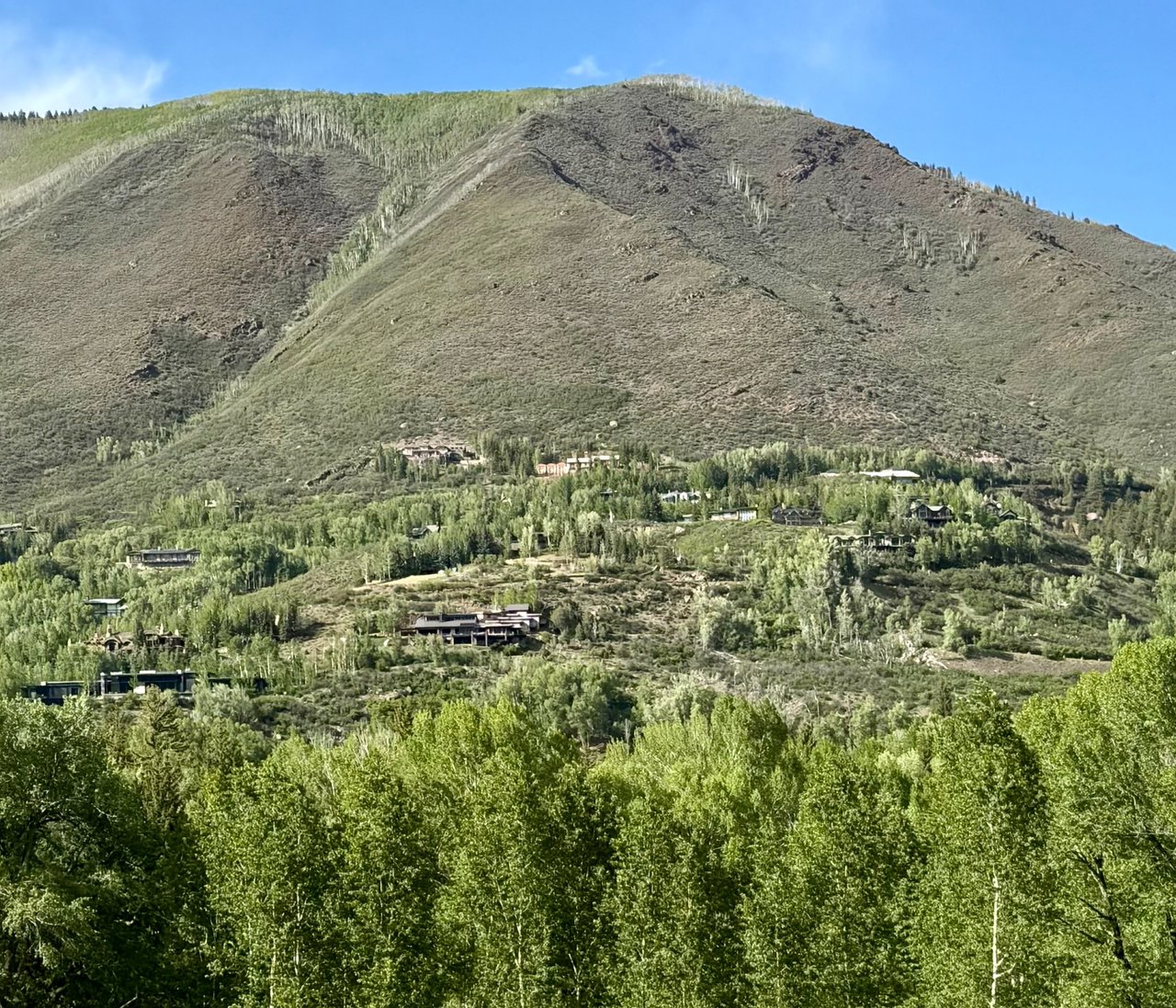
Red Mountain is a thin market by design. The neighborhood sits above downtown Aspen on a south-facing hillside with a fixed boundary — surrounded by US Forest Service and BLM land — and a hard ceiling on new inventory. In a market this constrained, one estate-scale transaction doesn't confirm a trend. It creates one.
The 2025 figure of $22.38 million reflects a year without a comparable outlier. That is not a weakening floor. It is an average returning to a range that still requires a buyer who can write a check north of $10 million to participate at entry level. For context: in 2025, Aspen recorded 31 homes sold above $20 million, with seven closing above $40 million. Red Mountain properties appeared in the top ten of that list.
The Three Forces That Hold the Floor
Understanding why Red Mountain holds its value independent of what any given year's average shows requires looking at what cannot be replicated.
Grandfathered square footage. Many homes on Red Mountain were built before Aspen imposed square footage restrictions on new construction. Those footprints cannot be recreated under current code. Buying an existing Red Mountain home is the only path to that scale.
Build cost as a ceiling, not a floor. New construction in Aspen runs between $2,000 and $4,000 per square foot before soft costs, according to 2026 market data from Steven Shane. Pitkin County also limits demolition allotments to as few as six per year under current policy. At those figures, replacement cost alone justifies asking prices that would look aggressive anywhere else.
No public transit. Red Mountain is one of the few Aspen neighborhoods not served by the city's transit system. For buyers who treat privacy as a primary asset — and on Red Mountain, it is — the absence of a bus route is a feature. Snow removal on steeper driveways requires deliberate planning, but that friction is priced in and accepted by the buyers who choose this neighborhood specifically for its separation from town energy.
These three forces are structural. They do not shift with a slow quarter, a low-snow winter, or a year without a nine-figure sale.
Reading Q1 2026 Correctly
The broader Aspen market did soften in early 2026. The Estin Report, covered by the Aspen Times in April 2026, showed Q1 closings were the lowest first-quarter performance since 2020. March closed sales across Aspen fell 50 percent year over year, from 24 in 2025 to 12 in 2026. The report pointed to two factors: a drought winter that dampened skiing and the buyer energy that follows it, and broader uncertainty around tariffs.
What does that mean for Red Mountain specifically?
A slow quarter in a thin, cash-dominant market reads differently than a slow quarter in a high-volume one. Over 70 percent of Aspen transactions close without financing. When buyers are insulated from rate cycles, a pause in activity more often reflects sentiment than a fundamental shift in what an asset is worth. The properties don't get cheaper when the buyers take a breath. The offers that do close in that environment tend to reflect negotiated value between parties who understand the scarcity — not distressed pricing.
The Estin Report's own language for the current market: Aspen is "globally desirable, supply-constrained and increasingly priced from the top down." That framing holds on Red Mountain more than anywhere else in the valley.
The Gradient Within the Neighborhood
The neighborhood average also obscures a meaningful internal range. Location on Red Mountain matters at a level of granularity that a single figure cannot capture.
Lower Red Mountain — particularly along Willoughby Way — commands the highest values for a specific reason: the combination of sweeping views and proximity to downtown is tightest at the base of the hill. From Willoughby Way, downtown Aspen is roughly a five-minute drive. The Hunter Creek Trail connects directly to the Rio Grande Trail at the neighborhood's edge, giving residents on-foot access to one of the Roaring Fork Valley's most-used multi-use corridors. From that same hillside, all four Aspen Snowmass ski areas are visible on a clear day, with views stretching from Independence Pass in the east to Mount Sopris in the west.
Higher on the mountain, the tradeoff runs in the other direction: more privacy, more elevation, steeper access, and driveways that require real winter management. The views expand. The proximity to town contracts slightly.
A buyer comparing a lower Red Mountain parcel to an upper one is not comparing the same asset at different prices. They are comparing different propositions. That distinction matters when you are trying to interpret what a sale two streets away actually tells you about the property in front of you.
FAQ
Does the Q1 2026 slowdown affect pricing on Red Mountain, or just volume?
Based on available reporting, the slowdown appears primarily in transaction count. The Estin Report's April 2026 analysis describes the Aspen market as supply-constrained and priced from the top down — language that suggests the ceiling hasn't shifted even as buyer activity paused. List prices on active Red Mountain inventory have not reflected distress.
Are there new construction opportunities on Red Mountain?
Rarely. Build costs of $2,000 to $4,000 per square foot before soft costs make speculative development prohibitive for most buyers, and Pitkin County's demolition policy limits replacements. Most available opportunities are resale homes or rebuilds, and the grandfathered footprints on existing properties are a meaningful part of their value.
How does Red Mountain compare to the West End at this price range?
They serve different buyers. The West End averaged $13.28 million in 2025, well below Red Mountain's entry point, and it offers walkability and historic architectural character rather than elevation and estate-scale privacy. A buyer choosing between the two is choosing between two different definitions of what luxury means in the same town.
What share of Red Mountain transactions close in cash?
Neighborhood-specific data isn't broken out publicly at the parcel level, but across Aspen broadly, over 70 percent of residential sales close without financing. Red Mountain's buyer profile — estate-scale assets, global wealth, discretionary timing — skews that figure higher still.
Red Mountain's story is not legible in the averages. It is legible in the specific properties, the specific parcels, and the specific timing — details that take years of watching this market to read correctly. Joshua Landis has lived in Aspen for more than 30 years and worked transactions across its most distinct neighborhoods. If you are trying to make sense of Red Mountain, let's connect.