
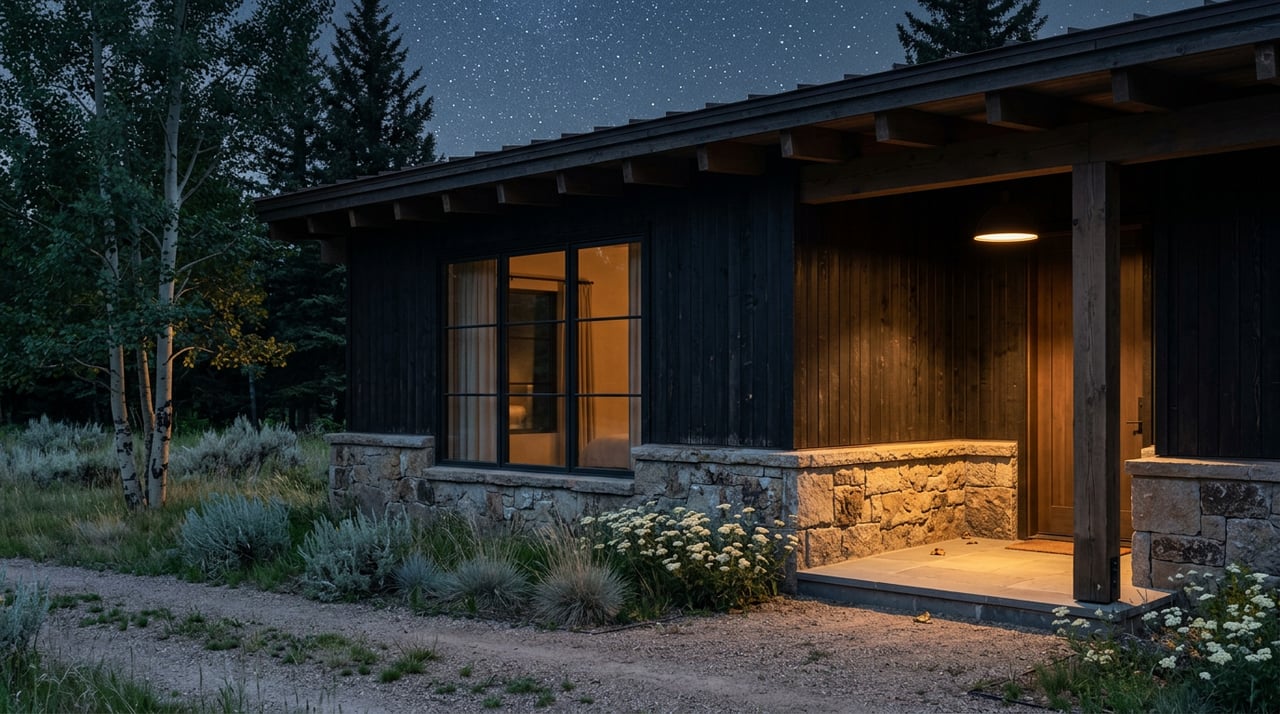
A visitor pulling off Highway 82 onto Snowmass Creek Road at eleven at night in August 2026 will notice the same thing they noticed in August 2019: the sky above Capitol Peak is genuinely, unfashionably black. The Milky Way sits where the marketing photos say it does. Satellites drift past in a way you cannot see from a Front Range subdivision.
What the visitor will not notice, and what has actually changed, is that the darkness overhead is now enforceable. In February, DarkSky International certified Old Snowmass as an International Dark Sky Community, the eighth in Colorado and one of a small group globally. The certification is not the story. The lighting code the certification rests on is the story, and it has been quietly rewriting what a summer night looks like from your own driveway.
What the Code Actually Says at Your Front Door
Pitkin County passed Ordinance 004-2025 in early 2025, replacing the county's 2006 lighting rules for the first time in nearly two decades. If you own a home in Old Snowmass, the operative details are not the mission statement, they are the specifics you now have to build against:
- Most exterior lights must be extinguished between 10 p.m. and 6 a.m., with narrow exceptions for businesses operating in that window and for street and parking lot lighting.
- Exterior bulbs must be 3,000 Kelvin or lower, an amber-warm tone rather than the bluish LEDs that spread across the county after 2015.
- Fixtures must generally be shielded so the light source directs downward, with residential properties in higher-activity zones allowed up to two unshielded fixtures.
- Residential exterior holiday lights are permitted only from November 15 through January 30. Non-residential holiday lighting runs to March 1.
- Any existing fixture that does not comply has to be replaced or retrofitted within five years of March 1, 2025.
That last line is the one most homeowners have not internalized yet. Within five years of March 1, 2025, all exterior light fixtures that do not conform to the requirements of this Section shall be replaced or retrofitted to comply, which puts the practical deadline at March 2030. A house sold in Old Snowmass between now and then transfers the retrofit obligation along with the roof and the septic. Two summers into the code, you should be reading the fixtures on your soffits the way you read the age of a water heater.
The code also carries a three-zone map, drafted with lighting consultant Bridal Lynch of Clanden Associates and county Development Services Manager Larissa LeBlanc. The proposal creates three mapped lighting zones roughly corresponding to remote/rural areas (LZ-0), mixed rural/suburban (LZ-1), and the more developed Airport–W. Maroon planning overlay (LZ-2). The code sets per-fixture lumen caps, an aggregate lumen allowance for properties based on house size, and a set of controls for nonresidential lighting including automatic timers and demand-reduction measures. The aggregate lumen cap tied to house size is the piece architects working in Old Snowmass are now designing to first, before they choose fixtures at all.
The Overlay, and Why Old Snowmass Got Its Own Layer
The countywide code is one document. Old Snowmass sits inside it as a specialized overlay, which is the part that actually earned the DarkSky designation. Established in 1974, the Snowmass Capitol Creek Caucus is a non-profit neighborhood organization whose goal is to preserve the natural environment and quality of life, and foster communication and participation within Colorado's Snowmass Creek and Capitol Creek valleys. The group worked alongside Pitkin County to successfully implement an updated, county-wide dark sky compliant lighting code, which also features a specialized code overlay specifically for Old Snowmass.
The advocacy inside that overlay came from a single subcommittee. Local resident Martha Ferguson organized WildSky Old Snowmass after noticing sky glow encroaching on the valley from downvalley construction, and drove the caucus application through the county process alongside photographer Ann Driggers and DarkSky Colorado chair Aaron Watson. The subcommittee's partners now include ACES, Aspen Skiing Company, Roaring Fork Audubon, Aspen Valley Land Trust, and the Lowell Observatory in Flagstaff.
Commissioner Jeffrey Woodruff, whose district includes Old Snowmass, framed the overlay less as a lighting rule than as a habitat rule. "The valley of Snowmass and Capitol Creek are critical wildlife habitats," Woodruff said. "Maintaining the night sky protects this crucial land and complements the protections we have put in place through conservation easements and additions to wilderness."
"Our intention is to safeguard the health of our residents and the survival of wildlife that depends on the dark of night. This certification is a testament to our collective effort to protect the quality and beauty of our shared night sky." — Martha Ferguson, WildSky Old Snowmass
The context Ferguson has cited repeatedly is post-2020 construction pressure. While Old Snowmass is celebrated for its remarkably dark skies, the region has faced increasing pressure from a post-COVID influx of residents. This growth brought a rise in residential construction and a subsequent threat of light pollution. To combat this, the Snowmass Capitol Creek Caucus, in partnership with WildSky Old Snowmass, spearheaded a rigorous initiative to safeguard the darkness. Read against the county's parallel debate over irrigation and native seed mixes in the Snowmass caucus overlay, the lighting rules read as one piece of a broader effort to keep the valley legible as a working ranching landscape rather than an exurb.
The August Nights the Rules Were Built For
For a resident, the code's payoff is not philosophical, it is calendar-shaped. The dark-sky infrastructure produces three anchor nights every summer, and they are the ones worth blocking off before out-of-town guests set your August for you.
Stars Above Aspen, August 10 at the top of Ajax. In its seventh year, the ACES partnership with Aspen Snowmass runs on Aspen Mountain at 11,212 feet, with WildSky Old Snowmass tabling as a program partner. August 10, 2026, 6pm-10:00pm, Aspen Mountain, tickets $32. You're invited to the top of Aspen Mountain for the 7th annual Stars Above Aspen Astronomy Night in partnership with Aspen Center for Environmental Studies. Scheduled events include a sunset yoga class for all ages from 6:30pm-7:30pm, Fiske Planetarium Minidome, collaborative universe mural, guided telescope stations, cosmic crafts, legends and facts of the constellations, and more. The Sundeck stays open for drinks and dinner. Kids ten and under are free, last gondola up is 9 p.m., last down is 10 p.m. The Fiske Planetarium Minidome inside the Sundeck runs twelve people at a time, so the practical move is to ride up early and grab a time slot before the sunset yoga class starts.
The Capitol Creek Caucus Picnic & Star Party at Buttercup Ranch. The caucus's annual mid-September gathering is the one night when the community organization that pushed for the overlay hosts its members under the sky it protected. The 2025 edition ran from 5 to 9 p.m. on September 13. The 2026 date will follow a similar rhythm and is worth watching the caucus notice board for. If you have not been, this is the resident version of Stars Above Aspen: fewer telescopes, better hayfields, closer neighbors.
The Perseid meteor shower. The Perseids peak overnight August 12 into August 13. With the code now in effect and the Snowmass Creek valley floor turned mostly amber under 3,000K, the shower reads from a driveway in Old Snowmass roughly the way it reads from the top of the gondola. That is a specific claim, and it is the one worth testing on a clear night this year. A north-facing porch, the exterior fixtures off by 10 p.m. per code, and a reclined chair is the setup.
Reading Old Snowmass Against the Rest of the County
The certification puts Old Snowmass in a small club. Old Snowmass joins 20 other places in Colorado with the certification, most of them being parks. Old Snowmass is the state's eighth Dark Sky Community, joining Westcliffe and Silver Cliff, Norwood, Nucla and Naturita, Ridgway, Crestone, Paonia, and Breckenridge. Breckenridge was the state's first resort town to earn the designation. Old Snowmass is the first unincorporated rural enclave in the Roaring Fork Valley to hold it, and the only one with a code overlay written specifically for its parcels.
The practical consequence, for anyone thinking about a house here five years out rather than five months, is that the darkness overhead is now a legally protected feature of the parcel in a way that the view is not. A neighbor cannot build a floodlit tennis court in 2028 the way a neighbor could have in 2018. That is the piece the DarkSky press release does not quite say out loud, and it is the piece that changes the resident math.
The velvety black that WildSky's founding language keeps returning to is not, in the end, a poetic asset. It is a maintained one. The porch light you swap out this fall is part of what maintains it. The August 10 gondola ride is part of what maintains it. The five-year retrofit clock is running quietly under both.
Old Snowmass in 2026 is one of the few places left in Colorado where the sky is getting darker on purpose. If you own a home here, or you are thinking about what stewardship of a valley parcel actually looks like beyond the closing table, Joshua Landis is glad to talk about how the overlay is showing up in appraisals, negotiations, and the small decisions homeowners are making about their soffits. Let's Connect.