
The portal says 405 acres for $56 million and lets the reader do the division. That math produces $138,000 an acre and a tidy comparison to the last ranch that traded. Both numbers are misleading.
Old Snowmass parcels are priced on entitlements, not acres. The Pitkin County Land Use Code decides how much house a buyer can actually build, whether the parcel keeps its original growth exemption after being reconfigured, and whether development rights can be severed and sold to someone else. Two ranches of identical size can carry very different stacks of those rights, and the gap explains most of the price dispersion buyers keep running into.
The Anchor Sale, Read Line by Line
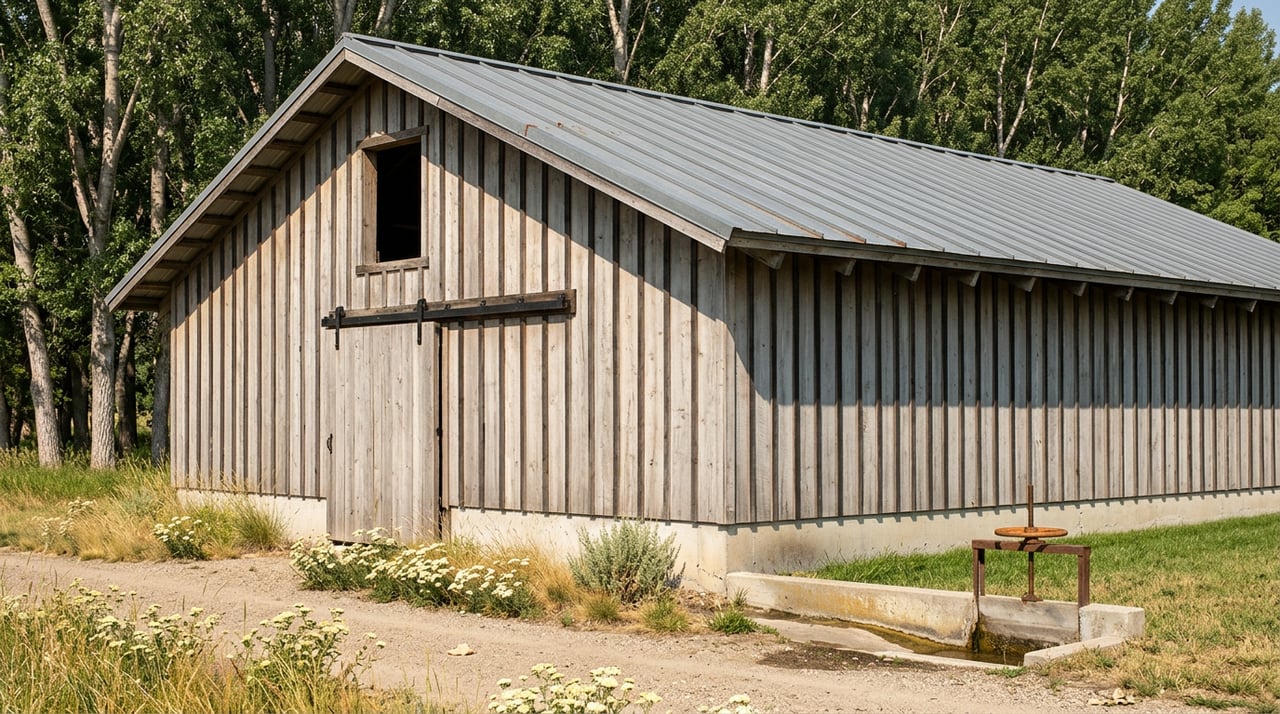
The McCabe Ranch closing on June 8, 2026 is the cleanest recent test of that thesis. The listing described two Pitkin County approved homesites totaling approximately 8,250 and 5,750 square feet with vested development rights in place through 2030, multiple older residences with several deed restricted units, an indoor riding arena, outdoor riding track, horse barns, two polo fields, historic cabins, and significant senior water rights. It sold for $56M on 405 acres at 1321 Elk Creek Road.
Read that pro forma backwards. What the buyer paid for was not pasture. It was the certainty that a 8,250-square-foot house and a second 5,750-square-foot house could be permitted through 2030 without going back through the growth allotment queue, plus water rights senior enough to irrigate meadows during a drought like the one that shortened the 2025-26 ski season, plus infrastructure already in the ground. Strip any of those elements out and the number falls.
The Number That Actually Governs House Size
Old Snowmass sits in unincorporated Pitkin County, which means the Land Use Code's floor area limits are the operative constraint on any future build. The relevant threshold is 5,750 square feet. Under the county's growth management framework, to construct a home of more than 5,750 square feet, up to a maximum of 15,000 square feet, a landowner can buy one or more TDRs, each worth 2,500 square feet of development, or seek additional square footage from the county's annual growth allotment.
The mechanics matter for a buyer comparing listings:
| Target house size | Base allowance | TDRs required |
|---|---|---|
| Up to 5,750 sf | Included | 0 |
| 8,250 sf | 5,750 sf | 1 |
| 10,750 sf | 5,750 sf | 2 |
| 13,250 sf | 5,750 sf | 3 |
| Up to 15,000 sf | 5,750 sf | 4 |
A TDR is a tradeable instrument. It is a development credit that allows property owners to transfer the right to develop from one parcel of land, known as a Sending Site, to another, called a Receiver Site. The McCabe listing's 8,250-square-foot approval was already sized and vested. A buyer walking into an equivalent parcel without that approval would need to acquire and land at least one TDR to reach the same house, and the county reminds applicants that the purchase of a TDR does not automatically guarantee approval of a receiver site for development.
That gap between "approved and vested" and "theoretically possible" is where most of the pricing dispersion in Old Snowmass lives.
Fathering Parcels, and Why 1978 Still Governs 2026 Closings
The other entitlement stacked into a ranch sale is easy to miss because its language sounds archaic. Pitkin County's code preserves the growth exemption attached to whatever parcel existed in the summer that Jimmy Carter was president. An original "fathering parcel" that was legally configured as of June 12, 1978, retains one GMQS exemption subject to the limitations of this section, notwithstanding any reconfiguration of the parcel after June 12, 1978.
Translated for a buyer: if a large ranch has been subdivided, lot-line-adjusted, or consolidated over the past forty-eight years, the original growth exemption still exists somewhere. The exemption shall be granted to the parcel that is designated in the subdivision or division of the original fathering parcel, or if no such parcel is designated then to the parcel that seeks the exemption first in time.
Two practical consequences follow.
First, in a subdivision where the fathering exemption was never formally designated, it can effectively be claimed by whichever owner files first. That is a race condition buried in a land use code, and it is worth diligencing before a contract is signed.
Second, common ownership can quietly erase a development right. The county cautions that under some circumstances, if two adjacent properties come under common ownership, only one development right may exist. A seller who assembled two neighboring parcels a decade ago may be marketing "two building sites" that the code no longer recognizes as separate.
Sending Sites: The Ranch That Is Also an Asset
The mirror image of the buyer's math is the seller's. Certain Old Snowmass parcels are eligible not to build, but to sever and sell their development rights to someone else building inside the Aspen Urban Growth Boundary. A property which contains a minimum of 160 acres, on which improvements and property are configured as they were on December 6, 2006, and on which no new development is proposed, may obtain special review approval from the Board of County Commissioners to become eligible to sever and sell TDRs. TDRs shall be awarded based on 1 TDR for each 35 acres, excluding 160 acres that are developed.
That formula matters when reading any Old Snowmass listing above 200 acres. A 405-acre parcel like McCabe, held as a Limited Development Conservation Parcel, would generate roughly seven TDRs after excluding the 160 developed acres. Each of those certificates lands somewhere in the county as 2,500 square feet of usable floor area on a receiver site, which is why they trade actively among Aspen builders.
The county describes the certificate itself as durable: a TDR Certificate is "irrevocable," and will remain valid until such time as it "lands" on a Receiver Site, at which time the development right will be retired and the Certificate is cancelled. That durability is the reason a buyer with a long horizon may quietly value a large sending-site parcel above what its pasture rents would justify.
The Market Context: Why This Matters More in Mid-2026
The gap between headline volume and entitlement value has widened this year. Q1 2026 was the weakest first quarter in the Aspen-Snowmass market since 2020. March closed sales fell 50% year over year, from 24 in 2025 to 12 in 2026, and Snowmass fell 46%, from 13 in 2025 to seven in 2026.
At the same time, the ultra-luxury end has been setting its own weather. Properties selling above $20 million became a defining feature of the Aspen market in 2025, with 42 sales over $20 million, up 62% from 26 sales over $20 million in 2024. The mechanism behind that number is the same one that drove McCabe: very wealthy buyers coming into the Aspen area with a compound mentality, interested in purchasing two adjacent lots, condos for staff, commercial buildings and more, and Tim Estin has noted that if you have sales like that, that raises all the homes in that neighborhood. Two of the three largest 2025-26 Roaring Fork Valley sales were Old Snowmass ranch assemblies. Media Mogul Byron Allen bought 76 Placer Lane in Aspen for $91.3M on June 1, 2026, and the 406-acre Old Snowmass McCabe Ranch with its fathering parcel sold for $56M on June 8, 2026. Six months earlier, St Benedict's Monastery with 3,738 acres in Old Snowmass sold for $120M on December 21, 2025.
Three sales in six months, all with entitlement structures that would take a full underwriting to understand, in a quarter where the broader transaction count fell in half. That is not a coincidence. When routine transactions slow, capital concentrates on assets whose scarcity can be documented. In Old Snowmass, scarcity is documentable line by line: fathering parcel yes or no, vested homesites and their expiration, TDR generation potential, water rights seniority.
Four Questions Before Signing an Offer
A ranch listing in Old Snowmass earns real diligence in four places.
- The fathering parcel. Ask for the plat and the chain of title back through subdivisions. Confirm that a chain of title documents ownership, the legal creation of the lot/parcel in compliance with County Subdivision regulations adopted for most parts of the County in 1972, and that the lot/parcel has a development right to transfer and has not merged with adjacent parcels.
- The vested approvals. McCabe sold with homesites vested through 2030. Vesting dates are contract terms buyers can and should verify with Pitkin County Community Development before removing due-diligence contingencies.
- The TDR math. Compare the base 5,750 square feet to the house the buyer actually wants. Every 2,500 square feet above the base requires a TDR that must be sourced, priced, and landed through a special review by the Board of County Commissioners.
- The sending-site option. On parcels above 160 acres, model the value of severing TDRs against the value of building. The two paths are mutually exclusive on any given acreage, and the more valuable one is not always the one the listing agent has framed.
FAQ
Is a "fathering parcel" the same as a building site? No. A fathering parcel is a legal configuration that existed on June 12, 1978. It carries one GMQS exemption forward through any subsequent subdivision. A parcel can be a building site without being a fathering parcel, and vice versa.
Can TDRs be used to build a new house on Old Snowmass land? Sometimes. TDRs generally provide floor area above the base cap. New dwelling units outside the Aspen Urban Growth Boundary have narrower TDR eligibility: a new dwelling unit located outside the Aspen Urban Growth Boundary may not be exempted from GMQS through the use of TDRs. That distinction is why receiver-site analysis is parcel-specific.
How long does the TDR severance process take? The county's own estimate for a constrained-site TDR: the process to obtain a "constrained" or "visually constrained" site TDR will typically take at least three months from the date of submittal of a complete application. Historic-designation and CD-PUD paths run longer.
What is happening on the demand side in mid-2026? Volume has softened while the ceiling has kept rising. Many sellers in Aspen have staying power, meaning they have the resources where they aren't desperate to sell and are unlikely to reduce prices significantly even as buyers enter a more wait-and-see mode, with 65-70% of all transactions done in cash. Entitled ranch parcels have been the exception to the slowdown.
Old Snowmass has always priced its legacy holdings on more than acreage, and the code is the reason. Reading a ranch listing well means reading the entitlement stack as carefully as the pro forma. For discreet diligence on a specific parcel or a preview of what is quietly circulating this summer, Joshua Landis is available. Let's Connect.